AI in Healthcare: The Revolution of healthcare is Already Here
AI, in simple terms, is like a super-smart assistant that learns from data and gets better at tasks requiring human intelligence, such as recognising patterns or making predictions.
Think of it as the Sherlock Holmes of technology, piecing together clues from medical images, patient histories, or even hospital schedules.
In healthcare, AI is not about replacing doctors or administrators. Instead, it acts as a powerful sidekick, amplifying what healthcare professionals already do best: caring for patients.
AI Principles and Techniques in Healthcare
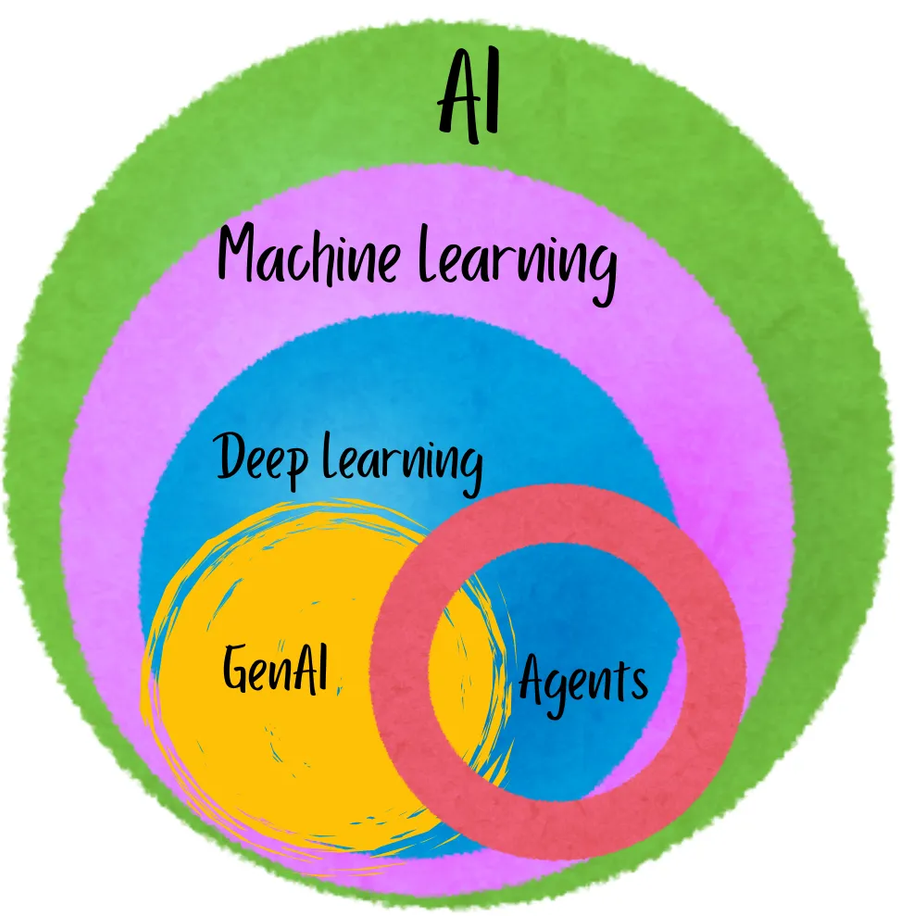
To understand how AI works its magic, we need to look at the techniques that power it.
AI relies on several subfields, each serving specific roles within healthcare systems.
Machine Learning and Deep Learning
Machine Learning (ML)
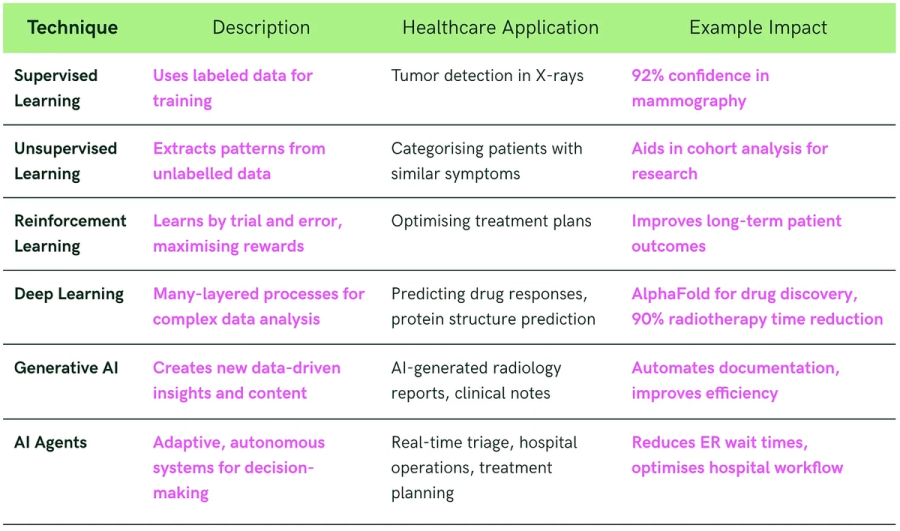
Machine Learning focuses on teaching computers to improve automatically through experience. It is generally categorised into three types:
Supervised Learning
Uses labeled datasets such as X-ray images tagged with “tumour” or “no tumour.” These models are widely used in radiology for automated tumour detection.
Unsupervised Learning
Extracts insights from unlabeled data. For example, AI can group patients with similar symptoms to detect patterns for cohort analysis and disease clustering.
Reinforcement Learning
In reinforcement learning, AI learns through trial and error or expert demonstration, maximising rewards over time. This approach has already driven major breakthroughs in treatment optimisation and healthcare research.
Deep Learning (DL)
eep learning is a class of algorithms built on multi-layered neural networks. These models excel at analysing complex healthcare data such as:
- Medical imaging
- Speech recognition
- Drug response prediction
- Clinical decision support
These techniques are already producing measurable results. For example:
- AI-driven diabetic retinopathy screening achieves 87% sensitivity and 90% specificity.
- Radiotherapy planning tools like InnerEye reduce planning time by up to 90%, significantly improving efficiency for oncologists.
Generative AI and Intelligent Agents
Generative AI (GenAI)
Generative AI builds upon machine learning and deep learning models to create new content rather than simply analysing data. Examples in healthcare include:
- Radiology report generation
- Patient case summaries
- Clinical documentation automation
- Disease progression predictions
In many ways, it acts like ChatGPT for clinicians, helping doctors quickly summarise cases and draft medical reports.
Agentic AI (AI Agents)
AI agents represent the next evolution of AI systems. These models combine deep learning, reinforcement learning, and symbolic reasoning to act autonomously and complete complex tasks.
Imagine AI agents that:
- Triage emergency room patients
- Allocate hospital resources dynamically
- Suggest treatment adjustments based on real-time patient vitals
Unlike traditional algorithms, these agents continuously learn and interact with their environment, making them powerful collaborators in healthcare systems.
Why AI is the Next Big Thing in Healthcare
AI is gaining momentum because it addresses some of healthcare’s biggest challenges:
- Long working hours
- Administrative overload
- Delayed diagnoses
The global AI healthcare market is projected to reach $188 billion by 2030.But the true value of AI lies not just in financial growth, but in improving care outcomes and operational efficiency.
AI tools such as Abridge (used by Kaiser Permanente) and MedScribe by Akeera can:
- Generate first drafts of clinical notes
- Summarise doctor-patient conversations
- Automate clinical documentation
This allows doctors to focus more on patient care and less on typing and paperwork.
AI in Diagnostics and Precision Medicine
AI has become an important assistant in medical imaging and diagnostics.
For example:
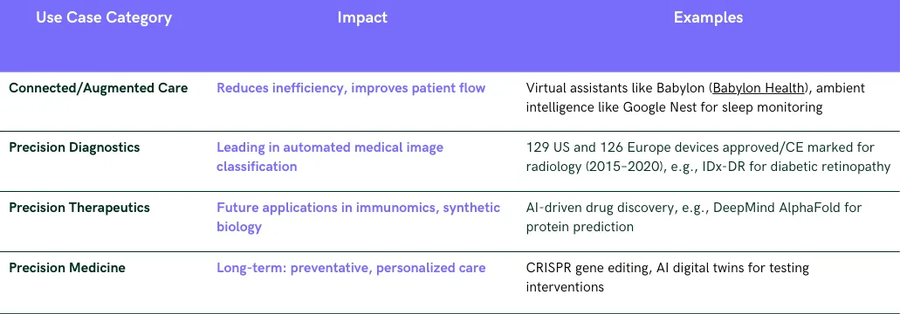
- iCAD’s ProFound AI, which is FDA approved, compares mammography images with 92% confidence in malignancy detection.
- AI systems can track lung cancer nodules automatically, ensuring consistent and reproducible analysis for oncologists.
By acting as a second pair of eyes, AI helps doctors reduce missed diagnoses and improve clinical accuracy.
The Future of AI in Precision Medicine
AI is also accelerating the development of precision medicine.
One major example is DeepMind’s AlphaFold, which predicts protein structures and has revolutionised drug discovery.
Looking ahead, AI-powered digital twins could allow doctors to simulate treatments for individual patients before applying them in real life.
This means healthcare could move toward preventing diseases before they even start.
The Evolving Role of AI in Healthcare
AI is transforming healthcare across several dimensions:
- Improving operational efficiency
- Enhancing patient outcomes
- Reducing healthcare costs
It enables early disease detection, better chronic disease management, and faster clinical decision-making.
However, AI remains assistive technology, not a replacement for medical professionals.
Think of it like GPS for doctors: it helps guide decisions, but the doctor remains firmly in control.
Organisations such as Cleveland Clinic’s AI Alliance are already working to ensure ethical and responsible AI adoption, focusing on:
- Patient privacyy
- Reliability
- Fairness and equity
A Call to Action for Doctors and Health Leaders
As someone who works both as a healthcare administrator and an AI scientist, my perspective is clear:
AI is not here to replace healthcare professionals. It is here to enhance their capabilities.
Think of AI as the Robin to Batman, a sidekick ensuring healthcare professionals can work smarter rather than harder.
For doctors, this means more time for meaningful patient interaction. For administrators, it means smoother hospital operations and smarter resource management.
The key is to adopt AI responsibly and ethically, ensuring technology continues to serve its most important purpose - delivering better care to patients.
Final Thought
AI in healthcare is no longer a futuristic concept.
It is already transforming hospitals by improving diagnostics, streamlining operations, and supporting clinical decision-making.
With strong ethical frameworks and growing adoption, AI is proving itself not as a threat but as a powerful partner for healthcare professionals.
The revolution is already here.